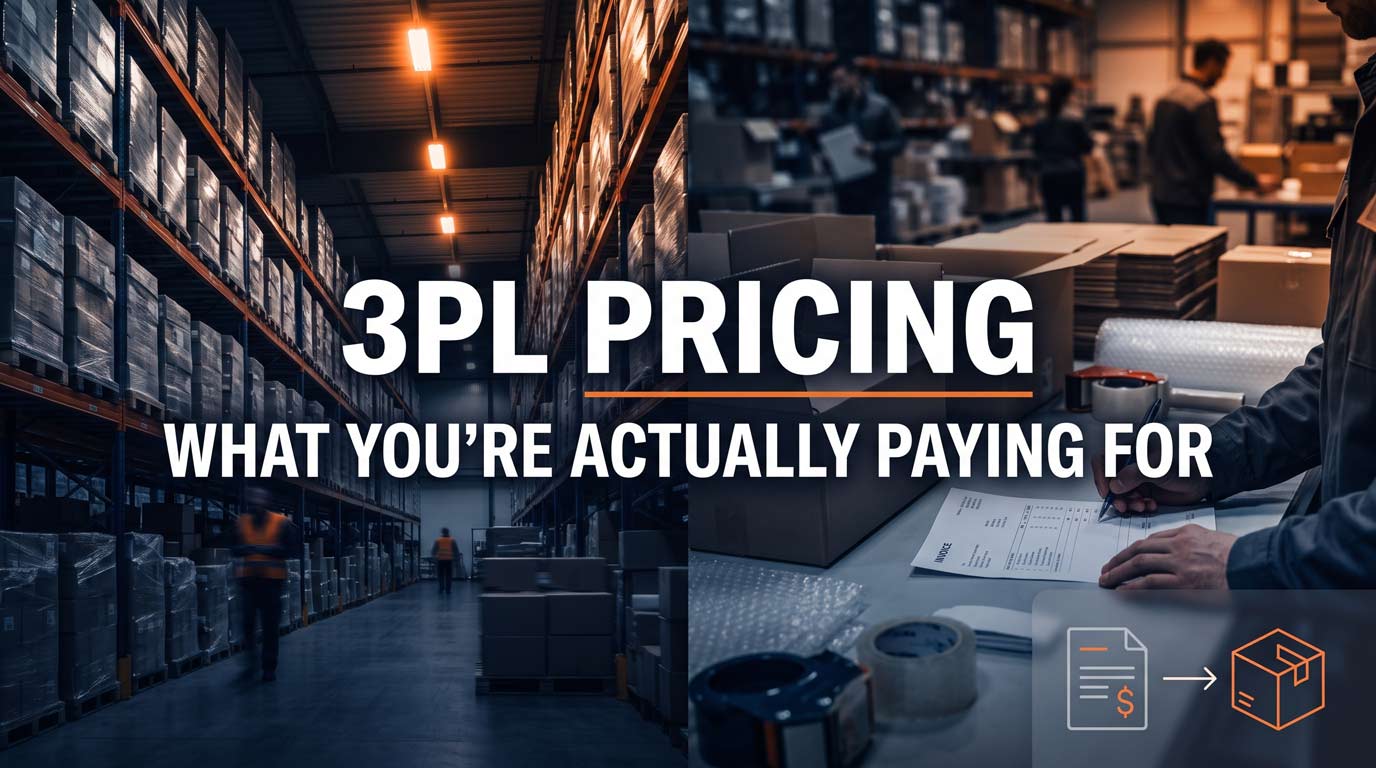
If you’ve ever put two 3PL quotes side by side and had no idea which one was actually cheaper, you’re not alone. 3PL pricing isn’t one number — it’s a stack of line items, and every provider slices them up differently. One quote might look like a bargain until you see the accessorial charges three months in.
Here’s what actually makes up a 3PL bill, and what to check before you sign.
The core fees every 3PL charges
Receiving/inbound fees. This covers unloading your inventory, counting it, and shelving it. Expect $25–$45 per pallet, or $0.35–$1.50 per unit if you ship in cases or loose cartons. Floor-loaded containers (no pallets) usually cost more to unload and often carry their own surcharge.
Storage fees. Typically billed per pallet per month, running $18–$25 on average — though the full range is closer to $7–$30 depending on your volume and region. Coastal warehouses and California facilities can run 30–60% above Midwest or Southeast rates. Low-volume shippers usually land at the top of that range; high-volume shippers negotiate toward the bottom.
Pick and pack fees. This is the fee for pulling an order and boxing it up. Most B2C orders run $2–$5 as a base fee, plus $0.30–$0.75 per additional item picked. Some providers price per order (flat), others per unit or per SKU — which matters a lot if your average order has multiple line items.
Shipping/postage. The 3PL passes through carrier rates, sometimes with a markup. This is one of the easiest places for a markup to hide, since you’re not always shown the underlying carrier rate. If you’re also weighing Amazon’s own fulfillment network against a traditional 3PL, the cost structure works differently — see our Amazon MCF vs. 3PL Fulfillment breakdown.
Setup/onboarding fees. Roughly half of 3PLs charge $250–$1,000 to onboard a new account before any product ships.
The fees that don’t show up on the first quote
These are the “accessorial” charges — extra work outside the standard scope — and they’re where most surprises come from:
- Long-term storage surcharges, triggered after inventory sits 180 or 365 days. These have become more common: nearly half of warehouses now charge them, roughly double the share from a year prior.
- Monthly account minimums — a floor you pay even in slow months.
- Returns processing fees, charged per unit to inspect, restock, or dispose of returned inventory.
- SKU or lot-tracking fees for catalogs with a lot of variants — especially if you’re running wholesale and DTC out of the same inventory pool. Here’s how to manage both from one 3PL.
- Peak-season surcharges, usually layered on top of standard rates from roughly October through December.
- Special handling charges for photos, custom labeling, kitting, or cycle counts.
- Exit fees — costs to pull your inventory out if you switch providers.
None of these are necessarily red flags on their own. The problem is when they’re vague or buried in a catch-all “miscellaneous” line instead of spelled out with a trigger and a rate.
How to actually compare two quotes
Line up quotes by category, not by bottom-line total — a lower headline rate with no storage cap or an aggressive long-term storage policy can end up costing more over a full year. A few questions worth asking directly:
- Is pick and pack priced per order, per unit, or per SKU?
- What triggers long-term storage, and what’s the rate once it kicks in?
- Is there a monthly minimum, and does it apply even if I don’t ship anything?
- Are shipping rates passed through at cost, or marked up?
- What does it cost to leave, if it comes to that?
Get every accessorial itemized in the contract — not just the headline rates — with a defined trigger for each one. A provider willing to write that down is telling you something; one that won’t is telling you something too.
The takeaway
3PL pricing looks complicated because it is complicated — but it’s not designed to be a mystery. Once you know the six or seven line items that make up a typical bill, comparing providers becomes a lot more straightforward. The goal isn’t finding the lowest number on page one of the quote — it’s understanding the full cost of a year with that partner.
Want to know what your own 3PL pricing would actually look like?
Skip the guesswork. Talk to our team and get a straightforward, itemized quote — no hidden fees, no surprises.
Get Your Custom Quote