A slick sales deck and a friendly rep will tell you almost anything you want to hear. What actually tells you whether a 3PL can run your fulfillment is how they answer the questions they’d rather not get.
Most bad 3PL relationships don’t start with a lie — they start with a question nobody asked.
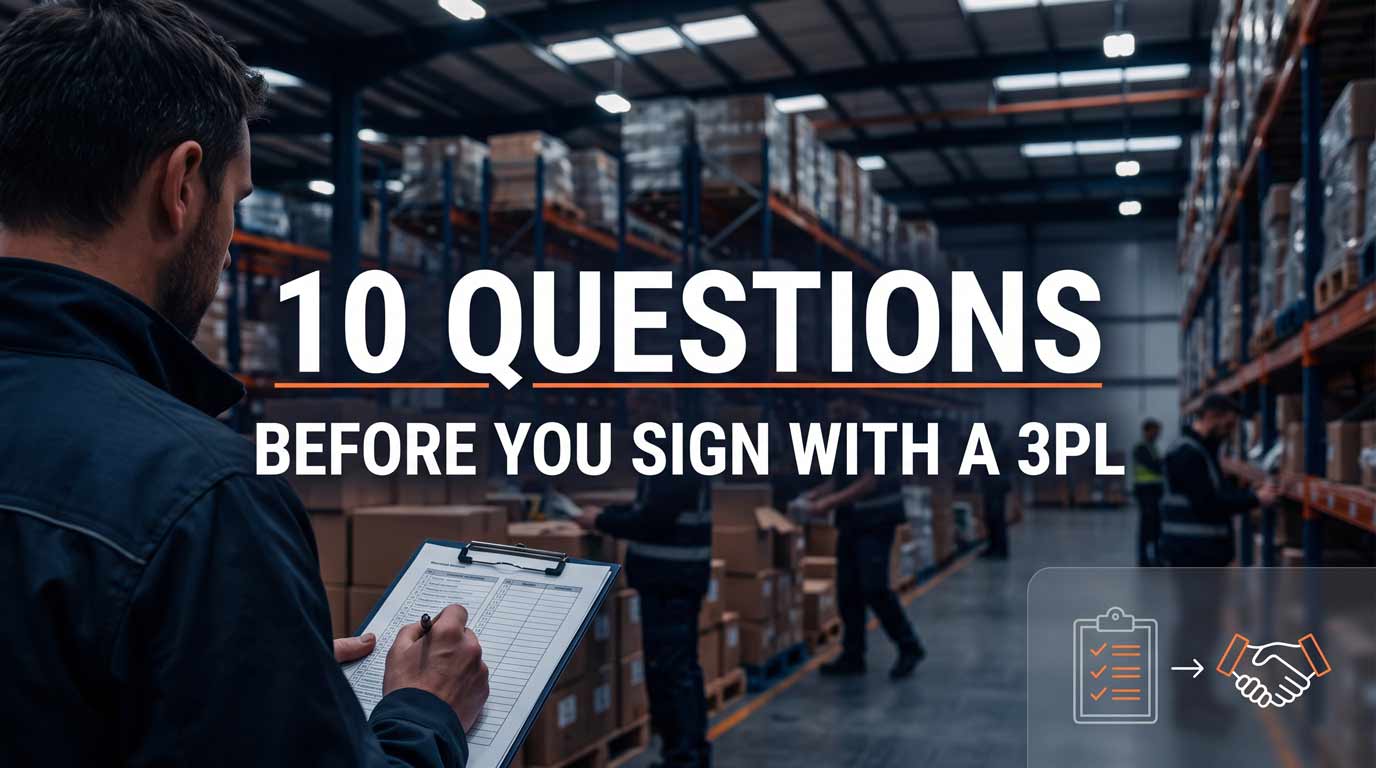
Here are the 10 questions worth asking before you sign anything.
1. What exactly is covered in your base rate — and what triggers an accessorial charge?
Every 3PL quote looks clean until the accessorial line items start appearing on month two’s invoice. Ask for a full breakdown of what’s included in receiving, storage, and pick-and-pack, and get a specific list of what falls outside that scope — long-term storage, kitting, special labeling, returns processing. If a provider can’t hand you that list on request, that’s the answer in itself.
2. Do I get real-time visibility into inventory and order status, or am I waiting on emails?
You should be able to see stock levels, order status, and shipping confirmations in a live portal — not chasing a rep over email when a customer asks where their order is. Ask for a demo of the actual dashboard before you sign, not just a description of it.
3. What SLAs do you commit to, and what happens when you miss them?
A service level agreement without a remedy attached isn’t really a commitment — it’s a suggestion. Ask for specific numbers: shipping accuracy rate, time-to-ship cutoffs, error rate.
A service level agreement without a remedy attached isn’t really a commitment — it’s a suggestion.
Then ask what happens when they miss those numbers. A 3PL confident in its operations will offer service credits or defined remedies for missed SLAs; one that won’t put anything in writing is telling you it doesn’t expect to hit its own targets consistently.
4. How do you handle peak season — do I get guaranteed capacity, or do I compete for space?
Plenty of 3PLs perform fine in July and fall apart in December. Ask directly what happens to your account during peak: do you have guaranteed capacity and staffing, or are you competing with every other client for the same limited floor space and labor pool? Ask about their track record — on-time ship rates during the last peak season is a fair thing to request.
5. What’s your rate escalation policy, and how much notice will I get before a price change?
Some contracts allow rate increases with as little as 30 days’ notice and no cap on the size of the increase — which is brutal if it lands in November. Ask for the specific escalation terms in writing: how much notice, how often rates can change, and whether there’s any ceiling on the increase.
6. How long is the contract, and what does it cost to exit early?
Look closely at contract length, auto-renewal clauses, and termination fees. A reasonable structure is a 12-month term with an annual rate review and a notice window of 60 days or more before auto-renewal kicks in. Termination fees that run more than a few months of minimum spend are worth pushing back on — that’s a lock-in mechanism, not a business safeguard.
7. What’s your average shipping accuracy and error rate?
Ask for real numbers, not a general assurance. A 3PL that tracks its own performance closely should be able to tell you its shipping accuracy rate (99%+ is a reasonable bar) without hesitation. Vague answers here usually mean they aren’t measuring it closely themselves.
8. How do you handle returns and reverse logistics?
Returns are where a lot of 3PL relationships get expensive fast. Ask how returns are processed, what it costs per unit, how quickly restocked inventory becomes sellable again, and whether they offer reverse logistics as a built-in service or something you have to manage separately.
9. Can you support the channels I sell on — DTC, wholesale, marketplaces, retail?
If you sell across DTC, wholesale, and Amazon, your 3PL needs to handle all of it out of the same inventory pool without creating separate silos or manual reconciliation work for you. Ask specifically how they manage multi-channel orders and whether your systems (Shopify, EDI, marketplace integrations) connect cleanly to theirs.
10. Can I talk to a current client with a similar order profile to mine?
A 3PL that’s confident in its service will connect you with an existing client running similar volume, similar SKU complexity, or a similar business model. If they can’t — or only offer a hand-picked testimonial instead of an actual conversation — treat that as a data point.
The takeaway
None of these questions are meant to be adversarial. A good 3PL will answer all ten without flinching, because they already operate this way. The ones worth walking away from are the ones that get vague, defensive, or evasive on more than one of them — because that’s usually a preview of what the relationship looks like six months after you’ve signed.
Already comparing 3PLs?
Ask us all ten questions. We’re happy to answer every one of them, in writing.
Talk to Our Team