Amazon ended in-house prep and labeling services on January 1, 2026, making port-adjacent FBA prep a more consequential decision than ever for brands importing through the East Coast. Every unit headed to an FBA fulfillment center now has to arrive fully compliant before it leaves your hands or your prep partner’s dock. That change, combined with Amazon’s expanded inbound defect fee schedule and ongoing inbound placement fee increases, has made the location of your FBA prep center a meaningful cost variable rather than just a convenience decision.
For brands importing through the Port of Savannah, the math is straightforward: a prep center minutes from the terminal gates saves $300 to $500 per container in inland trucking fees alone, compresses the container-to-Amazon timeline by days, and removes the coordination overhead that comes from managing drayage and prep as two separate relationships. Those savings don’t require any change to your sourcing strategy or your Amazon business. They just require using the right prep partner in the right location.
This post breaks down exactly where port-adjacent FBA prep saves money, why location compounds with compliance to affect your total inbound cost, and what to look for in a prep center near the Port of Savannah.
The Real Cost of an Inland FBA Prep Center
Most FBA sellers who use an inland prep center don’t think of location as a cost line. They think of it as a service fee — the per-unit prep rate — and compare that across providers. But for brands importing through an East Coast port, the total cost of FBA prep includes a leg of freight that’s often invisible in that comparison: moving the container from the port to the prep center.
That inland trucking leg — drayage from the terminal to a warehouse 200, 300, or 400 miles away — typically costs $300 to $500 per container depending on distance, lane, and chassis availability. On a shipment of 2,000 units, that’s fifteen to twenty-five cents per unit added to your actual prep cost before anyone has touched a single item. At 5,000 units, it’s still six to ten cents per unit. It adds up fast and it compounds across every shipment you make.
There’s also the time cost. A container that clears customs at Garden City Terminal and then trucks 300 miles inland to a prep center loses a full day of transit at minimum, often two, before prep can even begin. Add prep turnaround time — typically two to five business days at a professional center — and you’re looking at a week or more before inventory is on its way to Amazon. That’s a week of holding costs and a week of inventory that isn’t earning.
How Port-Adjacent Prep Compresses the Timeline
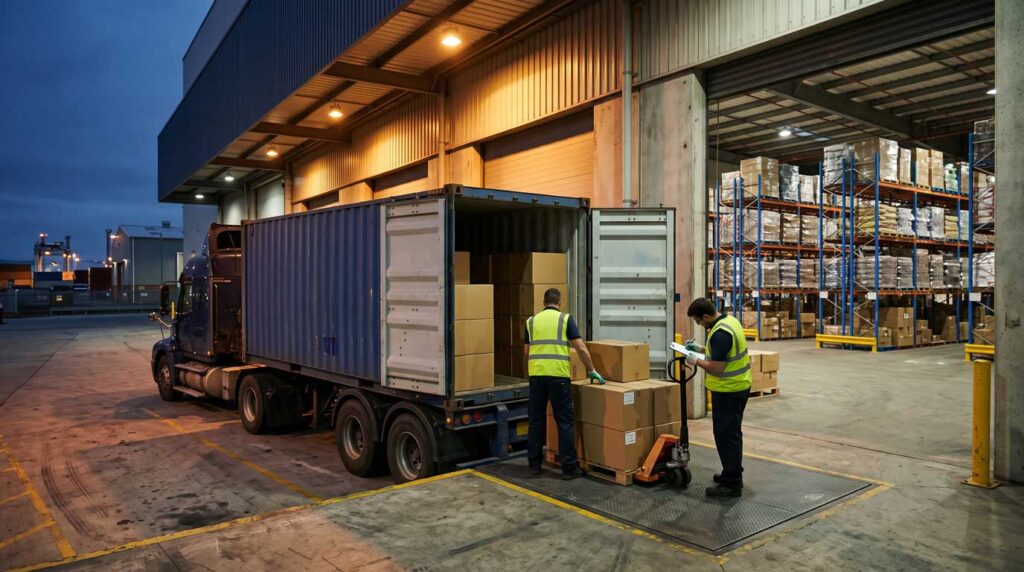
When your FBA prep center is minutes from the port terminal rather than hundreds of miles inland, the container-to-Amazon timeline changes structurally. A container that clears customs in the morning can be at the prep facility by afternoon. Same-day receiving, immediate inspection, and prep beginning the same day the container arrives are realistic operational outcomes rather than best-case scenarios.
That compression matters for two reasons. First, it accelerates your cash conversion cycle. Inventory that’s sitting in transit or waiting to be prepped isn’t earning revenue. Getting units into Amazon’s network faster means those units are available for sale faster, which matters especially for brands managing tight restock cycles or trying to avoid the low-inventory-level fee that Amazon expanded to more categories in 2026.
Second, it reduces your exposure to detention and per diem charges. Containers sitting at a terminal while you wait for an inland truck appointment are accumulating fees. A prep center with its own drayage operation or a direct drayage partner can move containers out of the terminal on a defined schedule that minimizes free time exposure.
Compliance and the 2026 Inbound Defect Fee
Amazon’s inbound defect fee, introduced as a consolidated charge in 2026, applies to shipments that arrive late, are misrouted, or fail to meet compliance requirements. The fee ranges from $0.32 to $5.72 per unit depending on the size tier and the nature of the defect. For a seller shipping 1,000 standard-size units with a labeling issue, that’s $320 to $570 in a single defect event — before the cost of any rework, reshipping, or delayed inventory.
Professional prep centers run compliance accuracy rates above 99 percent. DIY sellers average around 85 percent. That 14-point accuracy gap translates directly into defect fee exposure. A seller prepping in-house at 85 percent accuracy on a 5,000-unit shipment is sending roughly 750 units with some form of compliance issue. At even the low end of the defect fee range, that’s $240 in penalty fees. At the high end, the exposure is significant enough to eliminate the margin on that shipment.
A prep center that does this at volume, with trained staff and defined QC checkpoints, closes that gap. The per-unit prep fee looks like a cost. The defect fees you avoid by not prepping yourself are a savings that often exceeds the prep fee on a per-unit basis once you account for realistic DIY error rates.
Inbound Placement Fees and Why Prep Location Matters
Amazon’s inbound placement fee is charged when you ship inventory to fewer fulfillment centers than Amazon’s optimized split requires. For standard-size items, the fee runs from $0.20 to $0.70 per unit on a minimal split shipment. For larger items, the range is higher. Sending to Amazon-optimized locations (five or more inbound points) avoids the fee entirely, but requires shipping multiple smaller quantities to multiple destinations rather than a single consolidated load.
A prep center with strong carrier relationships and high shipment volume typically has better access to Amazon-optimized split routing at competitive freight rates than a seller managing this independently. The ability to aggregate volume across multiple clients, negotiate carrier rates, and build optimized multi-FC shipments is an operational capability that most individual sellers can’t replicate on their own.
For brands importing through Savannah specifically, the combination of port-adjacent receiving and optimized placement routing creates a compounding cost advantage: lower drayage cost on inbound, lower or eliminated placement fee on the Amazon side, and shorter total timeline between container and sale.
What Port-Adjacent FBA Prep Looks Like in Practice
Here’s how the workflow actually runs when drayage and FBA prep are handled by the same port-adjacent provider.
Step 1: Container Release and Drayage
Your customs broker files the entry and waits for CBP release at Garden City Terminal. Once cleared, your prep center’s drayage team schedules a pickup appointment and moves the container directly to the prep facility, typically within the same business day. There’s no separate drayage company to coordinate with, no scheduling gap between the port and the warehouse.
Step 2: Receiving and Inspection
The container is unloaded, counted against your packing list, and inspected for damage or discrepancies. You receive a receiving report confirming units, SKUs, and any exceptions. This happens on arrival rather than after a multi-day inland transit.
Step 3: FBA Prep
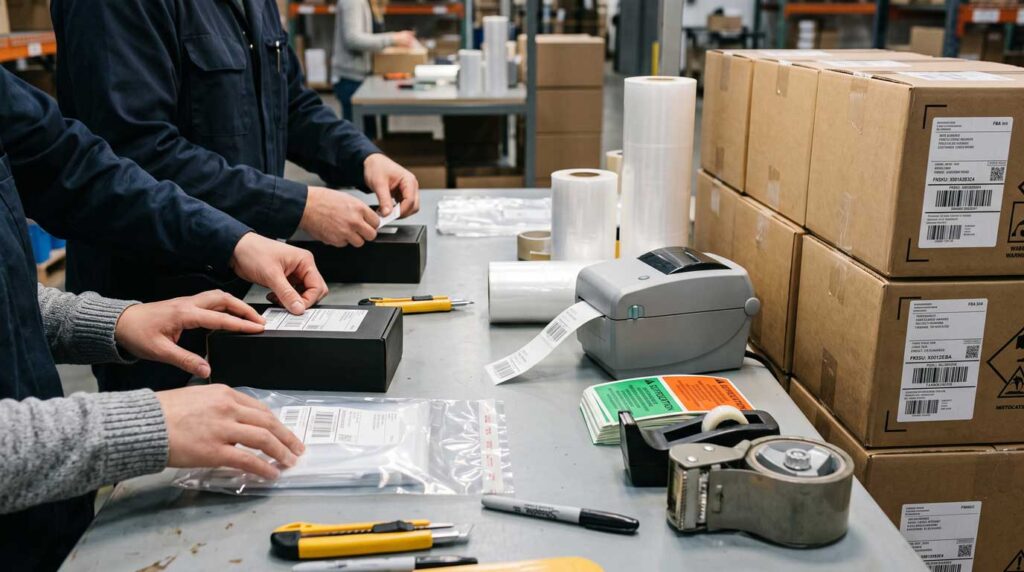
Units are prepped to Amazon’s current standards: FNSKU labeling, poly bagging where required, bundling, suffocation warnings on applicable packaging, and carton-level compliance. QC checkpoints catch issues before they become defect fees. Professional prep centers turn this around in two to five business days.
Step 4: Shipment Creation and Routing
Your prep center creates the inbound shipment plan in Seller Central, selects the placement option that minimizes your total cost (placement fee vs. freight cost), generates compliant carton labels, and ships directly to Amazon’s fulfillment centers via their carrier network.
Step 5: Inventory Goes Live
Units arrive at Amazon fulfillment centers compliant, on time, and ready to sell. Your inventory is live in the FBA network without having absorbed an inland trucking leg, a multi-day transit delay, or the compliance risk that comes with DIY prep.
How Port-Adjacent Prep Connects to Your Broader Fulfillment Strategy
For brands that sell on multiple channels — not just Amazon — a port-adjacent 3PL that handles FBA prep as part of a broader fulfillment relationship offers something a standalone prep center doesn’t: one inventory pool that serves every channel.
Instead of moving containers to a prep center, having units prepped and shipped to Amazon, and then managing a separate DTC or wholesale fulfillment relationship from different inventory, a full-service port-adjacent 3PL receives the container once, preps FBA-bound units, and simultaneously fulfills DTC and wholesale orders from the same stock. That consolidation eliminates the inventory split, the dual-provider coordination overhead, and the cost of moving product between two facilities.
For brands scaling from Amazon-only to multi-channel, this is often the cleaner operational path: establish a 3PL relationship near the port that handles FBA prep now and can grow into full omnichannel fulfillment as the business expands.
What to Look for in a Port-Adjacent FBA Prep Center
- Actual proximity to the port — ask for the specific distance from Garden City Terminal, not just ‘near Savannah’
- Integrated drayage or a direct drayage partner that eliminates the coordination gap between the terminal and the warehouse
- Verified compliance accuracy rate — a reliable prep center will have this data and share it; ask specifically about defect rates
- Amazon SPN membership or equivalent credential that signals Amazon has vetted their prep processes
- Experience with inbound placement optimization — ask how they handle shipment routing and whether they build Amazon-optimized splits
- WMS integration with your Amazon Seller Central account for automated order routing and real-time inventory visibility
- Capacity to handle your volume during peak — ask about their largest single-month unit throughput and their staffing model during Q4
- Multi-channel capability if you sell beyond Amazon — a prep center that only handles FBA is a narrower relationship than a 3PL that can grow with your full operation
Frequently Asked Questions
A port-adjacent FBA prep center is a warehouse located within a short distance of a major container port terminal — close enough that containers can be delivered directly from the port to the prep facility without a significant inland trucking leg. For sellers importing through the Port of Savannah, a port-adjacent prep center in Port Wentworth, GA, can receive containers the same day they clear customs at Garden City Terminal, compress the container-to-Amazon timeline, and eliminate $300 to $500 per container in inland trucking costs.
The savings depend on your shipping volume and what you’re currently paying for inland drayage. Port-adjacent prep centers typically save $300 to $500 per container compared to an inland prep center that requires a separate trucking leg from the port. On a shipment of 2,000 units, that’s $0.15 to $0.25 per unit in drayage savings alone, before accounting for faster turnaround time, reduced detention exposure, and lower inbound defect risk from professional prep accuracy.
Amazon’s inbound defect feeis charged when a shipment arrives at an FBA fulfillment center late, misrouted, or non-compliant with prep requirements. In 2026, the fee ranges from $0.32 to $5.72 per unit depending on size tier and defect type. Professional prep centers run 99%+ compliance accuracy, compared to approximately 85% for DIY prep. That 14-point accuracy gap means a meaningful portion of DIY-prepped inventory is generating defect fees on every shipment, and those fees often exceed the per-unit cost of professional prep.
The FBA inbound placement fee is charged when you ship to fewer fulfillment centers than Amazon’s optimized split requires. For standard-size items, the fee runs from $0.20 to $0.70 per unit on a minimal split. Sending to five or more Amazon-designated locations eliminates the fee entirely. A prep center with high shipment volume and strong carrier relationships can build Amazon-optimized multi-FC splits at freight rates that individual sellers typically can’t access independently, making the ‘zero placement fee’ option more cost-effective than it looks when managed on your own.
Faster prep turnaround means faster inventory availability in Amazon’s network, which means faster sales and faster cash conversion. A container that clears customs and reaches a port-adjacent prep center the same day can have units on their way to Amazon within two to five business days of arriving at port. An inland prep center adds days of transit before prep even starts. For sellers managing tight restock cycles or trying to avoid Amazon’s low-inventory-level fee, that timeline compression has a direct impact on both revenue and penalty fee exposure.
A full-service port-adjacent 3PL that handles FBA prep can typically also fulfill DTC orders and wholesale shipments from the same inventory pool. This eliminates the need to split inventory between a prep center and a separate fulfillment provider, reducing coordination overhead and total cost. The prep center receives your container once, preps FBA-bound units, and simultaneously fulfills other channel orders from the same stock. For brands selling on multiple channels, this consolidated model is often the most cost-effective path as volume grows.
Ready to Cut Your FBA Inbound Costs?
Ship8 is minutes from Garden City Terminal in Port Wentworth, GA — with integrated drayage, professional FBA prep, and a full fulfillment operation under one roof. Let’s talk about what port-adjacent prep could save your business.
Talk to Our Team