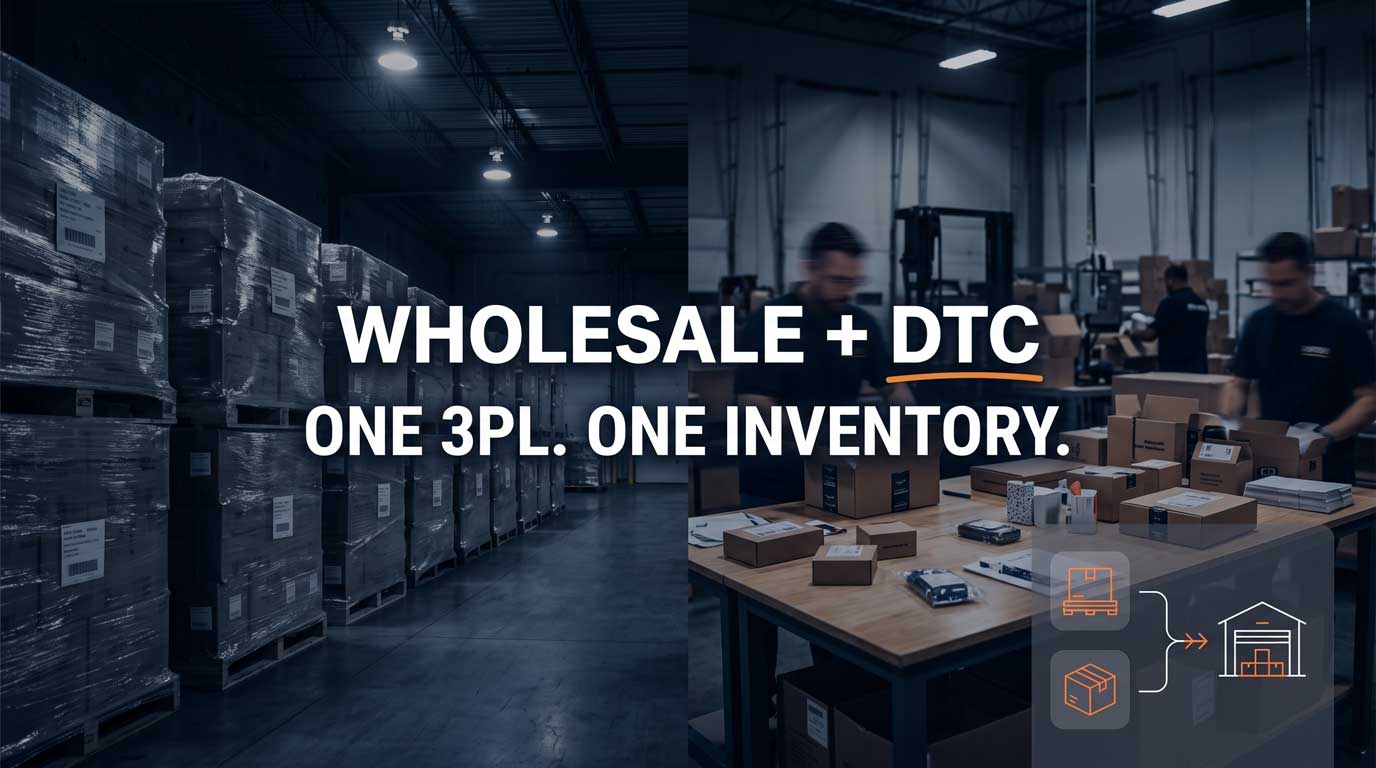
Most brands discover the gap between wholesale and DTC fulfillment at the worst possible moment — when a real retail purchase order arrives and someone actually reads the compliance requirements. Specific pallet configurations. EDI-formatted advance ship notices. Carton-level barcodes. A delivery window measured in hours. And a list of chargebacks waiting if any of it goes wrong. That’s a fundamentally different operation than packing individual parcels for Shopify customers, and running both from separate providers creates a fragmentation problem that compounds the longer it goes unresolved.
The brands managing this well in 2026 aren’t running wholesale and DTC as two separate logistics operations. They’re running both from a single 3PL with one inventory pool, one WMS, and one point of contact. That consolidation doesn’t just reduce complexity — it reduces cost, improves inventory accuracy, and removes the coordination overhead that kills margin in a dual-channel operation.
This post walks through what actually makes wholesale and DTC fulfillment different, why trying to manage them separately creates problems, and what to look for in a 3PL that can genuinely handle both.
Sources: NuORDER 2026 State of B2B eCommerce Report; GoBolt 2025 State of Logistics Report; industry DTC return rate benchmarks.
Why Wholesale and DTC Fulfillment Are Fundamentally Different
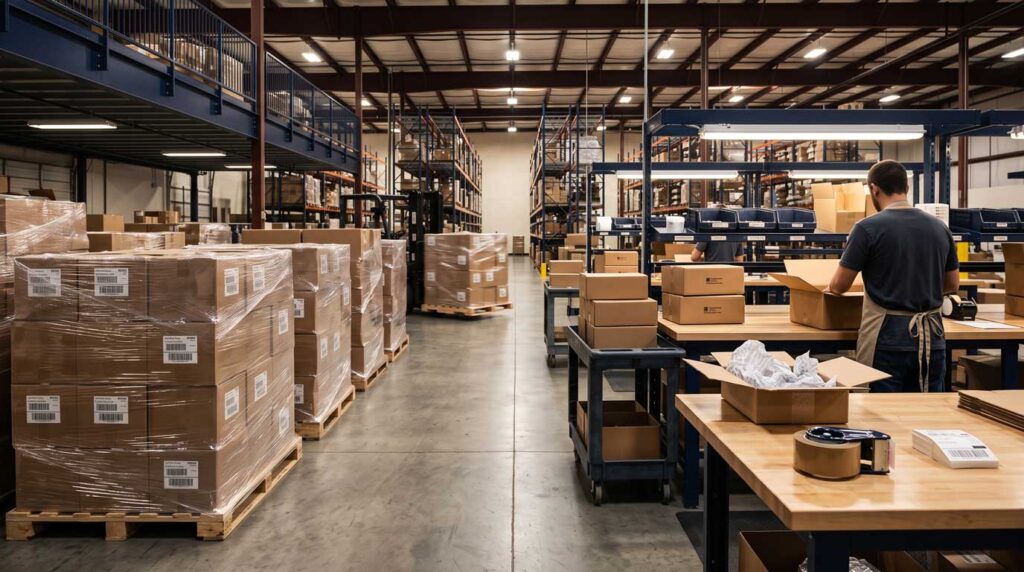
The gap between wholesale and DTC isn’t just about order size. It’s about every dimension of how an order is processed, packed, documented, and delivered. Understanding that gap is the starting point for building a fulfillment operation that handles both without creating conflict between them.
A DTC order arrives from a consumer, gets picked and packed individually, and ships as a parcel to a home address within hours of being placed. The packaging is often branded, the customer expects tracking updates, and return rates in categories like apparel run 20 to 30 percent, which means reverse logistics is a constant operational load.
A wholesale order arrives as a purchase order from a retail buyer, distributor, or B2B partner. It ships as a pallet or multiple pallets to a warehouse or store receiving dock, not a home address. The documentation requirements are non-negotiable: EDI-formatted advance ship notices, carton-level GS1 barcodes, specific pallet configurations, and in many cases retailer-specific routing guides that dictate carrier, label format, and delivery appointment windows. Miss any of it and you’re looking at chargebacks.
Key Differences Between Wholesale and DTC Fulfillment
| Factor | DTC Fulfillment | Wholesale Fulfillment |
|---|---|---|
| Order source | Consumer via Shopify, Amazon, or social commerce | Retailer or B2B partner via purchase order |
| Order size | Single units or small multi-unit orders | Case packs, pallets, or full truckloads |
| Packaging | Branded, consumer-ready | Carton-labeled, retailer-compliant, no consumer branding required |
| Documentation | Shipping label and tracking | EDI ASN, GS1 barcodes, packing lists, BOL, routing compliance |
| Delivery destination | Consumer home address | Retailer warehouse or store receiving dock |
| Timeline | Same-day or next-day fulfillment expected | Scheduled delivery appointment window, often measured in hours |
| Chargebacks | Returns managed order-by-order | Non-compliance chargebacks from retailer, can be significant |
| Returns | High volume, individual parcels, 20-30% rate in apparel & electronics | Negotiated at retailer level, not order-by-order |
What Breaks When You Try to Run Both Separately
The most common failure mode is split inventory. Brand A keeps DTC inventory at one 3PL and wholesale inventory at another, or at their own warehouse, because the two providers specialize in different things. On paper it sounds like using each partner for what they’re best at. In practice it means the same SKU is sitting in two locations, neither of which has full visibility into the other’s stock levels.
When a wholesale PO comes in larger than expected, you can’t pull from the DTC stock to fulfill it. When DTC demand spikes, you can’t access the wholesale inventory buffer. You’re making allocation decisions manually, across two systems, with two different teams. That’s where stockouts happen, where overselling happens, and where the margin you thought you were protecting on the wholesale side quietly disappears into coordination overhead.
The second problem is communication latency. Two providers means two sets of account managers, two portals, two billing cycles, and two places to call when something goes wrong. When a retailer asks for a proof of delivery on a shipment that went out three weeks ago, you’re not calling one person. You’re triangulating between your 3PL, the carrier they used, and whatever records your wholesale warehouse has in their system. That takes time you don’t have.
Common Signs Your Dual-Channel Fulfillment Isn’t Working
- Frequent stockouts on one channel even when inventory exists on the other
- Manual inventory reconciliation across two systems at the end of each week
- Retailer chargebacks that trace back to label or documentation errors your 3PL didn’t catch
- Slow responses when a wholesale partner requests PODs, ASN confirmations, or compliance documentation
- DTC order delays during peak periods because warehouse capacity is being consumed by a large wholesale shipment
- Two separate invoices with overlapping line items you can’t reconcile cleanly
What a 3PL That Handles Both Actually Looks Like
A 3PL that can genuinely manage wholesale and DTC from a single operation isn’t just a warehouse with two different areas. It’s a provider whose warehouse management system, process design, and team structure are built to handle two fundamentally different order types simultaneously without one degrading the other.
Many brands also require value-added services that support both wholesale and DTC operations, including kitting, subscription box assembly, FNSKU labeling, pallet rework, retail display builds, custom packaging, quality inspections, and returns processing. Having these services performed under one roof eliminates additional transportation, reduces handling, and shortens order cycle times.
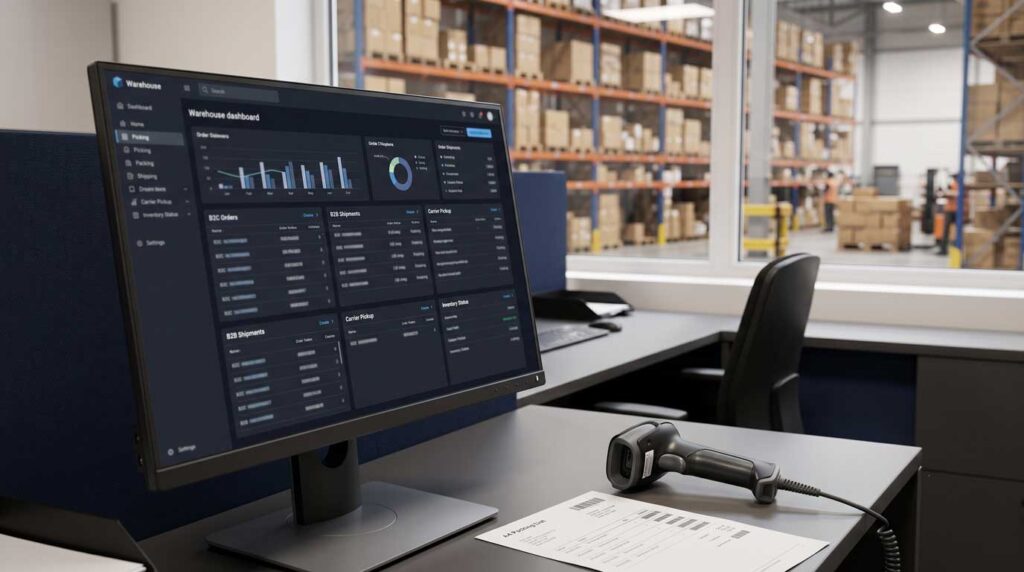
The WMS is the foundation. It needs to support parcel shipping workflows for DTC orders including Shopify, Amazon, Walmart Marketplace, BigCommerce, WooCommerce, SPS Commerce, and EDI retail integrations and EDI-compliant pallet workflows for wholesale, in the same system, against the same inventory. That means one set of SKUs, one stock count, and real-time visibility into allocation across both channels. When a DTC order comes in at the same time as a wholesale replenishment request, the system knows exactly what’s available and what’s committed, without anyone having to manually check two different portals. Process separation within a shared facility matters too. DTC and wholesale fulfillment don’t run on the same physical workflow even in a consolidated operation. A good 3PL has dedicated pick-and-pack areas for DTC orders, separate staging zones for wholesale pallet builds, and QC checkpoints that catch compliance issues before a shipment leaves the dock, not after a retailer sends a chargeback. The inventory is shared. The processes are distinct.
Why Technology Matters as Much as Warehouse Space
Warehouse capacity alone isn’t enough. The technology behind the operation determines how efficiently wholesale and DTC fulfillment can coexist. A modern warehouse management system should provide real-time inventory visibility, automated order routing, barcode validation, ASN generation, parcel carrier integration, and API connectivity with ecommerce platforms and ERP systems. Without those capabilities, warehouse staff are forced to rely on spreadsheets, manual inventory adjustments, and disconnected systems that increase both labor costs and fulfillment errors.
As brands expand into additional sales channels, the WMS becomes the operational control tower that keeps inventory synchronized across every marketplace, retailer, and fulfillment workflow.
EDI and Retail Compliance: The Wholesale Requirement Most Brands Underestimate
EDI, electronic data interchange, is the communication standard most major retail buyers use to transmit and receive purchase orders, advance ship notices, and invoices. If your wholesale partner requires EDI and your 3PL doesn’t support it, every document in that workflow has to be handled manually, which is slow, error-prone, and a consistent source of chargebacks.
An EDI-capable 3PL receives the purchase order electronically, generates an ASN automatically when the shipment is ready, and sends the invoice without manual intervention. That automation is what keeps wholesale fulfillment from becoming a full-time compliance management job on your end.
Beyond EDI, retail compliance requirements vary by buyer. A shipment to a major national retailer has different label specs, pallet configurations, and routing requirements than a shipment to a regional distributor. A 3PL that has done this before will have routing guides and compliance templates already built for major retail partners. One that hasn’t will be building those processes alongside you, at your expense in chargebacks.
Wholesale Compliance Checklist for 3PL Evaluation
- EDI support for 850 (PO), 856 (ASN), and 810 (invoice) transaction sets at minimum
- GS1 barcode compliance at the carton and pallet level
- Retailer-specific routing guide management and carrier compliance
- Chargeback dispute support and documentation tracking
- Delivery appointment scheduling and on-time delivery performance tracking
- Case pack and pallet configuration flexibility across different buyer requirements
Inventory Allocation: The Hardest Part of Running Both Channels
The trickiest operational challenge in a dual-channel operation isn’t the fulfillment itself. It’s inventory allocation. You have one pool of stock and two types of demand pulling at it simultaneously: wholesale POs that are large, scheduled, and committed, and DTC orders that are unpredictable, immediate, and individually higher margin.
The tension between them is real. Wholesale orders are often placed weeks or months in advance on net payment terms, which means you’re committing inventory before you know what DTC demand is going to look like during the same period. Prioritize wholesale and you risk stockouts on DTC during a peak. Prioritize DTC and you risk shorting a retailer who’s counting on a full PO. The way well-run brands manage this is with soft allocation. Rather than physically segregating inventory between channels, they set safety stock thresholds and channel-level allocation rules in the WMS. Wholesale commitments are tracked as reserved inventory, DTC orders draw from the available balance, and the system flags when available stock drops below the threshold needed to cover committed wholesale orders. That’s not possible with two separate providers. It requires one WMS with full visibility into both channels.
Returns: The DTC Complexity Wholesale Brands Aren’t Ready For
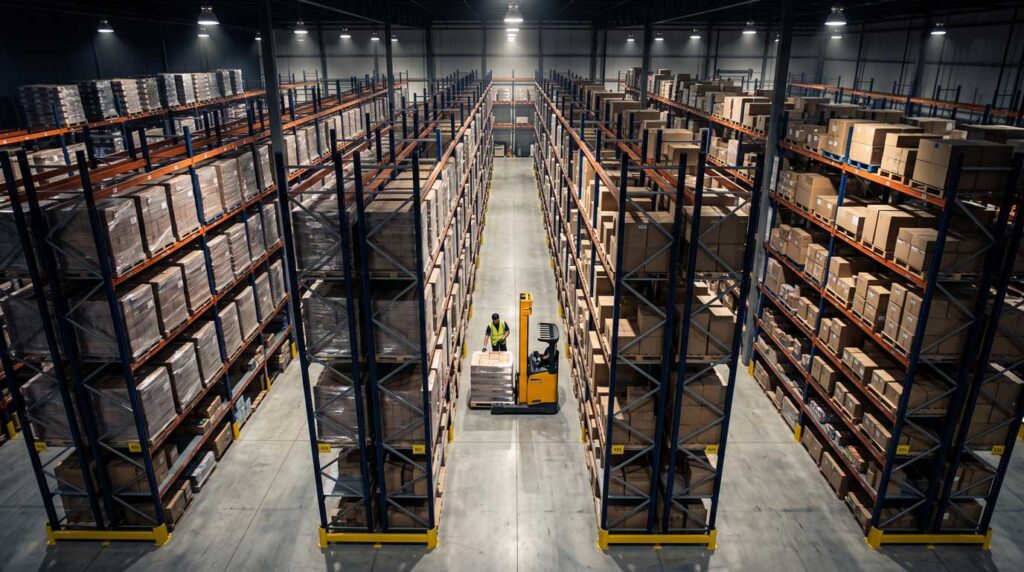
If you’re adding DTC on top of an existing wholesale operation, returns are the operational complexity that tends to catch brands off guard. Wholesale returns are negotiated at the retailer level and arrive in predictable, structured batches. DTC returns arrive constantly, individually, in varying condition, from consumers who may or may not have followed return instructions.
A 3PL managing DTC returns needs a reverse logistics workflow that can receive individual units, inspect condition, make a disposition decision (restock, quarantine, liquidate, destroy), and update inventory in real time. That process has to run in parallel with inbound receiving from suppliers and outbound fulfillment for both DTC and wholesale orders, without creating congestion on the receiving dock.
Efficient reverse logistics also provides valuable business intelligence. Tracking return reasons, product condition, and disposition trends allows brands to identify recurring quality issues, reduce future return rates, and improve customer satisfaction while recovering inventory that can be quickly returned to available stock.
Return rates in DTC categories like apparel and electronics run 20 to 30 percent. For a brand doing meaningful DTC volume, that’s a constant operational load. A 3PL that hasn’t built a dedicated returns workflow into their operation will feel that load in ways that affect your outbound fulfillment performance.
What to Ask a 3PL Before You Consolidate Channels
Not every 3PL that says they handle wholesale and DTC can actually do both well at the same time. A few specific questions will surface the difference quickly.
Ask how they handle EDI compliance for retail partners and whether they have existing setups for the specific retailers you sell to. A good answer names specific retailers and describes the process. A vague answer suggests they’ve done it theoretically but not operationally.
Ask how inventory is managed across channels in their WMS and how allocation rules work. If the answer involves manual spreadsheet reconciliation at any point, that’s a red flag.
Ask for specific examples of chargeback rates and how they’re managed. A 3PL with real wholesale experience will have this data and be willing to discuss it.
Ask how returns are processed and what the average turnaround time is from receipt to restocked inventory. If they don’t have a defined SLA for this, it suggests returns haven’t been a priority in their operation.
Key Questions for 3PL Evaluation
- Do you have existing EDI setups for major retail partners, and which ones?
- How does your WMS handle inventory allocation across wholesale and DTC simultaneously?
- What is your process for retail compliance documentation, and how do you handle chargeback disputes?
- Can you share chargeback rates and on-time delivery performance data from current wholesale clients?
- What is your returns processing SLA for DTC orders, and how does the reverse logistics workflow run?
- Do you have dedicated staff for wholesale compliance, or is it handled by the same team as DTC?
- How do you handle peak periods when DTC volume spikes at the same time as a large wholesale shipment?
Why Savannah Is an Ideal Distribution Hub
Savannah has become one of North America’s fastest-growing logistics markets due to the continued expansion of the Port of Savannah, extensive interstate access, and proximity to major East Coast population centers. Brands that import products through Savannah often reduce inland transportation costs while positioning inventory closer to consumers and retail distribution networks throughout the Southeast and Eastern United States.
The Case for Consolidating Sooner Than You Think
Most brands wait until the operational pain of running two separate providers becomes undeniable before they make a change. By that point, they’ve absorbed months of chargeback losses, inventory reconciliation overhead, and coordination delays that were preventable.
The case for consolidating wholesale and DTC fulfillment into one 3PL is strongest before you feel the pain, not after. When you’re still setting up your wholesale relationships, your 3PL compliance processes, and your DTC fulfillment workflows, consolidating them into one operation from the start is dramatically less disruptive than migrating inventory and processes from two separate providers after things have been running for a year.
The brands that consistently outperform competitors don’t view fulfillment as a cost center; they treat it as a competitive advantage. By consolidating wholesale and DTC fulfillment with a single experienced 3PL, they gain better inventory visibility, faster order processing, fewer compliance issues, and a scalable infrastructure capable of supporting future growth. As new retail partners, ecommerce channels, and marketplaces are added, the fulfillment operation is already positioned to scale without rebuilding processes or splitting inventory across multiple providers.
Frequently Asked Questions
Wholesale fulfillment involves shipping large orders — pallets or case packs — to retail buyers, distributors, or B2B partners with strict compliance requirements including EDI documentation, GS1 barcodes, and retailer-specific routing guides. DTC fulfillment involves picking and packing individual orders for consumers, shipping as parcels, and managing returns at the individual order level. The two channels follow fundamentally different workflows, documentation standards, and service level expectations, which is why running both from a single 3PL requires a provider whose WMS and processes are specifically built for that complexity.
Yes — a 3PL with the right WMS and operational design can manage wholesale and DTC orders from a single shared inventory pool with channel-level allocation rules. This eliminates the stockout and reconciliation problems that come with split inventory across two providers. The key is that the WMS must natively support both EDI-compliant wholesale workflows and parcel-based DTC fulfillment simultaneously, not handle one channel well and treat the other as an afterthought.
EDI, or electronic data interchange, is the communication standard most major retail buyers use to transmit purchase orders, receive advance ship notices, and process invoices. An EDI-capable 3PL can receive a PO electronically, generate an ASN automatically when the shipment is ready, and send an invoice without manual intervention. Without EDI support, every wholesale document has to be handled manually, which increases error rates, slows the process, and creates consistent exposure to retailer chargebacks.
Retail chargebacks are fees a retailer deducts from payment when a supplier fails to meet compliance requirements — wrong label format, incorrect pallet configuration, missing ASN, late delivery, or wrong carrier. They can be significant, often two to five percent of the invoice value per violation. A 3PL with real wholesale experience will have routing guide management, compliance QC checkpoints before shipments leave the dock, and chargeback dispute support to challenge deductions that are incorrect.
The most effective approach is soft allocation through the WMS — wholesale POs are tracked as reserved inventory, DTC orders draw from the available balance, and the system flags when available stock drops below the threshold needed to cover committed wholesale orders. This requires a single WMS with full visibility into both channels. Brands trying to manage allocation manually across two separate providers typically end up with stockouts on one channel or the other during peak periods.
The strongest time to consolidate is before the operational pain of running two providers becomes undeniable — ideally when you’re setting up wholesale relationships or adding a new DTC channel, rather than after you’ve been running fragmented operations for a year. Signs that consolidation is overdue include frequent inventory reconciliation across two systems, retailer chargebacks that trace back to fulfillment errors, and delays when wholesale and DTC demand peaks at the same time.
One Inventory. Every Channel. One Partner.
Ship8’s fulfillment campus in Savannah, GA supports wholesale and DTC operations from a single inventory pool — with EDI integrations, retail compliance, parcel fulfillment, kitting, FNSKU labeling, returns processing, and direct port access all under one roof.
Talk to Our Team