In almost every pricing conversation we have with a new customer, there’s a version of the same frustration: “Why is my fulfillment invoice higher than the quote?”
The assumption is usually that something changed commercially.
In reality, it’s almost always operational.
A fulfillment quote is built on a defined set of assumptions.
An invoice reflects what actually happened inside the four walls of the warehouse.
When those two things don’t match…………the cost moves.
For high-growth brands, understanding this difference is the key to controlling cost-to-serve and scaling profitably.
Quotes Are Built on Assumptions. Invoices Are Built on Activity.
Every fulfillment proposal is modeled on a specific operating profile:
- Inbound type
- Inventory configuration
- Order mix
- Unit of measure (each, case, or pallet)
- Throughput volume
If any of those change or were inaccurate at the start, the labor model changes with them.
That’s where the variance comes from.
The 5 Most Common Reasons Your Fulfillment Cost Increases
1. Each Picking Replaces Case Picking
This is the single biggest cost driver.
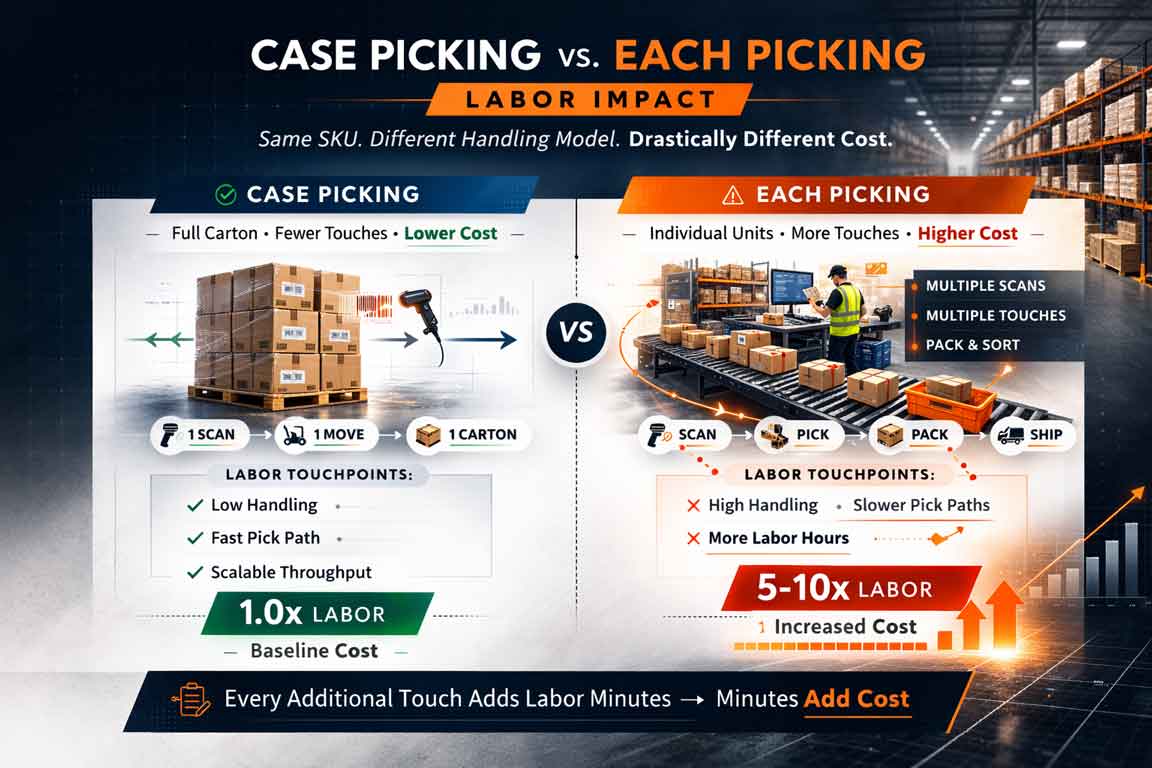
If the quote assumes full-case picking but the cartons are mixed, inconsistent, or missing case-pack data, the operation is forced into each-level handling.
That can increase labor by 5–10× per order.
With warehouse labor representing one of the largest variable cost drivers in fulfillment — as reflected in U.S. Bureau of Labor Statistics data on warehousing employment and wages — even small shifts in handling complexity can materially impact invoice totals.
Not because the 3PL changed the price……………but because the physical work changed.
2. Inaccurate or Incomplete Master Data
Your WMS can only execute what your data allows.
Missing or incorrect:
- Case-pack quantities
- Carton dimensions
- Weights
- Units of measure
results in:
- manual handling
- re-slotting
- rework
- slower pick paths
All of which increase cost.
3. The Inbound Doesn’t Match the Operating Plan
Most quotes assume a defined inbound structure; typically palletized, labeled, and uniform.
What actually arrives is often:
- floor-loaded containers
- mixed SKUs per pallet
- inconsistent labeling
- damaged or non-compliant freight
That creates unplanned labor before the product is ever available to ship.
4. The Order Profile Changes
You priced:
- Wholesale bulk distribution
But you’re shipping:
- DTC multi-line, multi-unit orders.
That is not a small shift…………it’s a completely different labor model.
5. Accessorials Are Triggered by Behavior
Accessorial charges aren’t random, they’re event-driven.
Examples:
- Storage exceeding the modeled turns
- Peak volume outside forecast
- Special projects
- Non-compliant routing guides
- Labeling or rework requirements
These reflect real activity in the building.
The Operator Perspective: Cost Is Engineered Upstream
Sophisticated brands don’t spend time disputing invoices.
They control the inputs that determine the invoice.
That means:
- Clean inbound standards
- Accurate SKU master data
- A validated order profile
- Clear commercial scope in the SOW
Fulfillment cost is not a billing function.
It’s an engineering outcome.
Modern supply chain leaders increasingly model operations using structured cost-to-serve frameworks, similar to those outlined by the Council of Supply Chain Management Professionals (CSCMP), where labor, touchpoints, and flow design directly determine margin impact.
How High-Performance Brands Keep Quotes and Invoices Aligned
At SHIP8, the customers who scale the fastest and most profitably do five things before go-live:
A defined inbound routing guide ensures product arrives palletized, labeled, and structured in a way that matches the operating model. When inbound varies from the agreed standard, unplanned labor is introduced before the first order ever ships — and that drives cost variance.
Case-pack quantities, carton dimensions, weights, and units of measure must be operationally accurate inside the WMS. Incomplete or incorrect data forces manual handling, re-slotting, and rework — all of which increase labor and slow throughput.
Forecasts are theoretical. A true order simulation tests actual SKU mix, order complexity, and unit handling requirements. This validates the labor model before live volume begins and prevents unexpected invoice variance.
Each vs case vs pallet handling fundamentally changes the labor profile. A shift from case picking to each picking can increase touches per order by 5–10×. Aligning on unit of measure upfront ensures the quote reflects the real operating model.
Accessorial charges are event-driven, not arbitrary. Defining storage thresholds, peak volume parameters, and special project criteria upfront eliminates billing surprises and creates transparency on both sides.
Fulfillment Cost Is a Growth Lever (Not Just an Expense)
If your invoice is consistently higher than your quote, the issue isn’t pricing.
It’s a misalignment between:
how your operation is modeled
and
how your product actually flows.
Fix that and fulfillment becomes predictable, scalable, and margin-accretive.
Want to Know What Your Operation Should Actually Cost?
At SHIP8, we run cost-to-serve diagnostics for brands that are scaling or transitioning providers.
We identify:
- the real labor model
- the data gaps
- the operational constraints
- the commercial structure required to support growth
Because the goal isn’t a lower invoice.
It’s a fulfillment operation that performs exactly the way it was designed to.