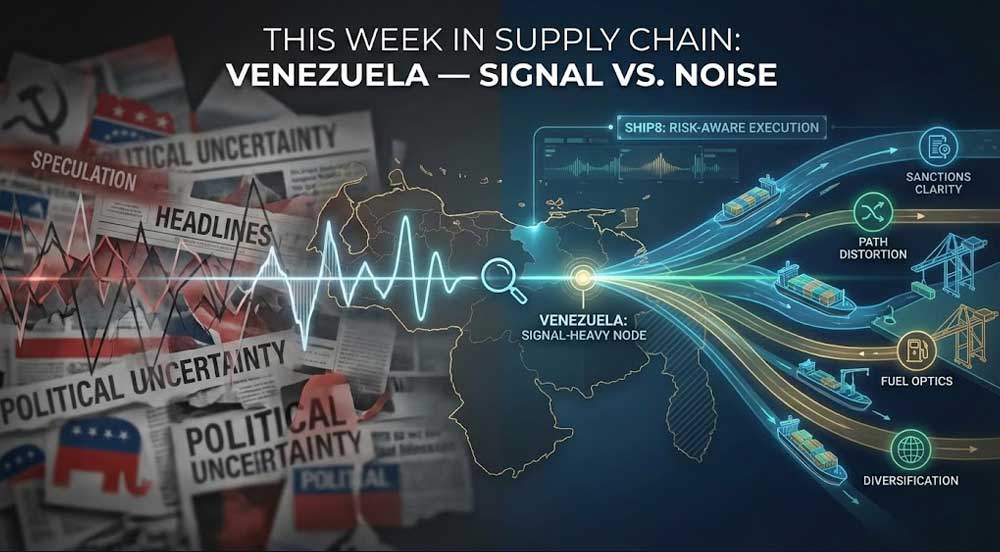
This week, Venezuela sits squarely at the intersection of geopolitics, trade policy, and logistics risk. Tariffs, sanctions, and carrier exposure are converging there, making it a signal-heavy node for supply chains—even as headlines threaten to pull the conversation into speculation.
At SHIP8, the goal isn’t to take a political stance. It’s to understand how politics distorts freight lanes, how diversification protects customers, and how operators should respond calmly and deliberately.
Here’s the signal vs. noise view—through a risk-aware execution lens.
SIGNAL: Venezuela Is a Risk Multiplier, Not a Volume Driver
Venezuela’s relevance right now isn’t about scale—it’s about concentration of risk.
What’s intersecting:
- Sanctions and tariff exposure that complicate contracting and payments
- Carrier risk tied to insurance, compliance, and vessel routing
- Energy optics that amplify market reactions beyond physical flows
Even modest volumes moving through Venezuelan-linked lanes can carry outsized operational friction.
Signal takeaway: Venezuela matters because risk compounds there, not because it moves the world’s freight.
SIGNAL: Politics Distorts Freight Lanes Before It Disrupts Ports
Political uncertainty rarely shuts ports overnight. What it does—quickly—is distort decision-making upstream.
Operators and carriers respond by:
- Rerouting to avoid compliance ambiguity
- Adding buffers that lengthen transit times
- Passing along higher insurance and documentation costs
Ports like La Guaira and Puerto Cabello may remain operational, but freight lanes around them become less efficient and more expensive.
Signal takeaway: The first disruption is path distortion, not port closure.
SIGNAL: Sanctions Clarity Matters More Than Political Outcomes
From a supply-chain execution standpoint, policy clarity beats political optimism.
What actually changes logistics behavior:
- Clear sanctions guidance and licensing
- Predictable enforcement standards
- Bankability of contracts and insurance
What does not:
- Speculation about leadership outcomes
- Short-term political narratives
Signal takeaway: Freight moves on policy, not predictions.
NOISE: “Venezuela Will Reshape Global Trade”
Despite the headlines, Venezuela:
- Is not a major global container hub
- Does not anchor critical just-in-time manufacturing flows
- Has already been partially designed out of many networks
Global trade lanes adapt. What changes is risk pricing, not topology.
Noise takeaway: This is not a global trade reset.
NOISE: Political Analysis Disguised as Supply Chain Insight
Commentary that focuses on who wins or loses politically adds very little value for operators.
Supply chains care about:
- Can I move freight compliantly?
- Can I insure it?
- Can I price it accurately?
- Can I offer my customer certainty?
Anything else is editorial.
Noise takeaway: Politics explains why risk exists—but not how to execute around it.
Why Diversification Protects SHIP8 Customers
Events like this reinforce a core principle SHIP8 builds around: diversification over dependency.
That means:
- Avoiding over-concentration in politically sensitive lanes
- Maintaining alternative port and routing options
- Structuring inventory and fulfillment to absorb shocks without panic
Diversification doesn’t eliminate risk—it prevents single-point failure.
Execution reality: Optionality is resilience.
Fuel & Energy: Where Optics Outpace Reality
Venezuela still influences energy psychology, which can:
- Trigger fuel surcharges
- Compress carrier margins
- Create short-term pricing volatility
But physical fuel availability and export capacity remain structurally constrained.
Signal takeaway: Watch fuel costs—but expect lag between headlines and real supply changes.
How to React Without Speculating
For shippers and operators, the correct response is disciplined—not reactive:
Do
- Monitor sanctions, guidance and enforcement updates
- Validate carrier insurance and compliance exposure
- Maintain routing flexibility
- Communicate risk transparently with customers
Don’t
- Re-engineer networks based on political headlines
- Assume rapid recovery or collapse
- Take positions outside your operational control
Bottom Line
Venezuela is a signal-heavy geopolitical node—where tariffs, sanctions, and carrier risk intersect.
- Politics distorts freight lanes before it stops freight
- Diversification protects customers from concentrated risk
- Execution, not speculation, is where value is created
SHIP8’s role isn’t to predict outcomes. It’s to execute through uncertainty with discipline, optionality, and trust. If geopolitical risk is starting to influence your inbound or outbound planning, this is a good moment to pressure-test your network design.
That’s how risk-aware logistics actually works.