In the logistics industry, there’s a belief that automation alone is what turns a warehouse from good to world-class. Add robots, bring in smarter equipment, wire up a few sensors, and throughput magically jumps.
At SHIP8 INC., we’ve learned the opposite.
Robots absolutely help, and we’re investing heavily in them. But the largest efficiency gains we’ve ever achieved came before a single robot touched the floor. They came from people, from our operators, engineers, supervisors, and CI team — applying the Theory of Constraints, fixing flow, and reducing touches in the places that mattered most.
Automation scaled the improvements. People created them.
This article breaks down what truly drives throughput in a hybrid warehouse and why reducing touches and elevating constraints are the real levers behind every productivity jump.
Table of contents
- The Industry Myth: “Robots Increase Throughput By Themselves”
- The Theory of Constraints in a Robotic Warehouse
- Reducing Touches: The #1 Driver of Warehouse Throughput
- People Create the Efficiency — Robots Scale It
- Right-Time Automation: Installing Tech Too Early Creates Waste
- Robots + People: The Hybrid Throughput Engine
- Reducing Touches + TOC: The Two Levers That Control Everything
- Conclusion: Throughput Comes From Humans — Scaled by Robots
The Industry Myth: “Robots Increase Throughput By Themselves”
Every automation vendor paints a similar picture:
install technology → throughput rises → labor cost drops.
But warehouses aren’t closed-loop machines.
They’re open systems full of variability, exceptions, human decision-making, SKU complexity, and space constraints.
Automation increases throughput only when it is placed at — or supports — the actual constraint.
Not upstream of it.
Not beside it.
Not in a department with capacity.
If your bottleneck is packing, robots in picking won’t matter.
If your bottleneck is a replenishment lag, robotics in putaway won’t solve it.
If your bottleneck is labeling or carton prep, no equipment downstream is going to fix the upstream issue.
This is why the Theory of Constraints still defines modern fulfillment; even in robotic buildings.
The Theory of Constraints in a Robotic Warehouse
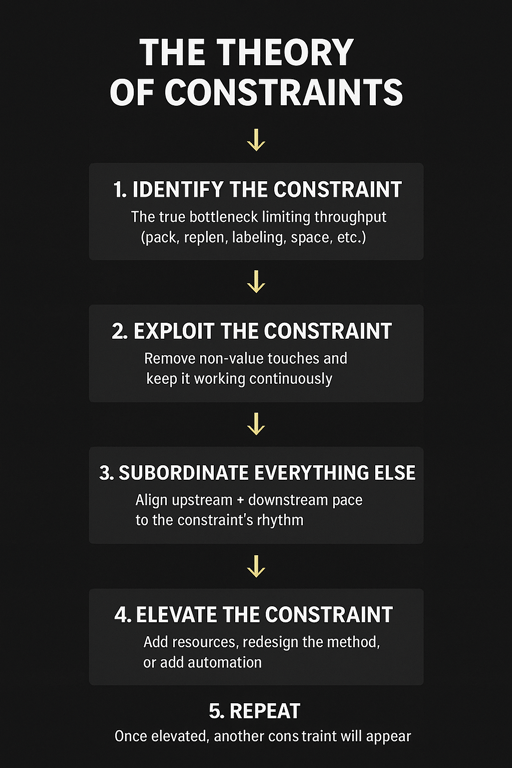
TOC says every operation has one constraint at any moment:
- Inbound unload pace
- Labeling speed
- Replenishment lag
- Pick travel distance
- Pack station capacity
- Carton prep
- QA/exception handling
Throughput only increases when that constraint is elevated.
And here’s the part most people overlook:
Automation doesn’t eliminate constraints — it exposes them.
Robots move fast.
But they reach your bottleneck faster too.
This is why SHIP8 always follows the same sequence:
- Define the constraint
- Reduce touches feeding the constraint
- Stabilize method + pace
- Standardize the flow
- Only then — automate the repeatable portion
Robots are multipliers.
They multiply whatever system you give them — good or bad.
Reducing Touches: The #1 Driver of Warehouse Throughput
Touches are the hidden tax of fulfillment.
Each unnecessary touch adds:
- Time
- Motion
- Re-handling
- Decision-making
- Congestion
- Quality risk
- Labor cost
In furniture, oversized, and high-mix SKUs, the cost is even higher because each touch requires more space and more physical effort.
At SHIP8, the biggest leaps in throughput didn’t come from new machines — they came from touch reduction:
- Fewer handoffs
- Fewer back-and-forth movements
- Fewer decisions forced onto operators
- Fewer return trips
- Fewer staging piles
- Fewer “touch this later” moments
Reducing touches not only speeds up flow — it prepares the process for automation, because robots thrive in repeatable environments.
People Create the Efficiency — Robots Scale It
There’s a pattern we see repeatedly:
- We redesign the process.
- We remove touches and travel.
- Throughput jumps immediately.
- Then automation magnifies those improvements.
This is the reverse order most 3PLs use.
Automation should not cause efficiency.
Automation should multiply efficiency that already exists.
Robots excel at:
- Long-distance travel
- Repetitive movements
- Predictable handoffs
- High-frequency transport
Humans excel at:
- Judgment
- Exception handling
- Quality work
- Method redesign
- Continuous improvement
- Simplifying complexity
The highest-performing warehouses let each side do what it’s best at.
Process Improvements That Didn’t Require Automation (But Changed Everything)
Some of our most valuable throughput gains came from simple, human-driven improvements to flow, movement, and slotting logic.
1. Dynamic Tier-Rack Storage
High-volume SKUs moved closer to outbound.
Lower-volume SKUs shifted farther out.
This kept motion tight and eliminated wasted travel, all without automation.
2. Mixed-Unit Pick Lanes
Reorganizing lanes around SKU breadth (not just category) removed zone-hopping and kept pickers flowing instead of zig-zagging across the building.
3. Full-Pallet Picking With Automatic Pallet Retrieval
For large items, we implemented a system where the picker:
- Pulled the full pallet,
- Emptied the location, and
- Retrieved the empty pallet in the same trip.
This saved an entire follow-up task.
Inventory stayed cleaner and tighter.
Replenishment became more predictable.
All done by humans — and all a major touch reduction win.
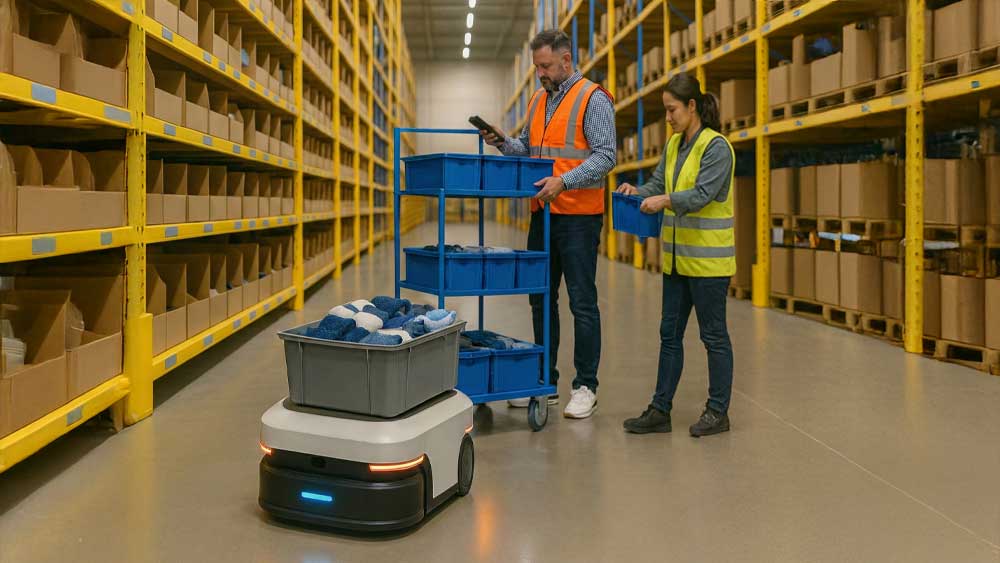
4. Cluster Picking With Smart Carts (Human Efficiency Multiplied)
A major advancement in our eCommerce process came from implementing cluster picking with mobile smart carts.
Pickers could now:
- Pick multiple customer orders at once,
- Sort items into bin positions on the cart as they moved, and
- Deliver several completed orders directly to pack stations.
Cluster picking eliminated:
- Return trips
- Redundant walking
- Staging piles
- Single-order inefficiencies
It materially increased throughput — without robotics.
5. Single-Piece-Flow Packing for Oversized
Shifting to one-piece flow removed staging buildup, reduced decision congestion, and kept pack stations continuously fed without the chaos of batch work.
All people-driven.
All low cost.
All core TOC victories.
None required a robot.
Right-Time Automation: Installing Tech Too Early Creates Waste
Installing robotics before stabilizing the process is how warehouses become slower, not faster.
Premature automation leads to:
- Robots feeding non-constraints
- Expensive idle equipment
- More WIP, not more throughput
- Rigid processes that block future improvements
- Variability amplified, not reduced
At SHIP8, we automate only after:
✓ Takt time is defined
✓ Variation is controlled
✓ Touches are eliminated
✓ Flow is steady
✓ The constraint is elevated
✓ The new standard is stable
When automation meets a stable system, it accelerates.
When automation meets chaos, it magnifies chaos.
Robots + People: The Hybrid Throughput Engine
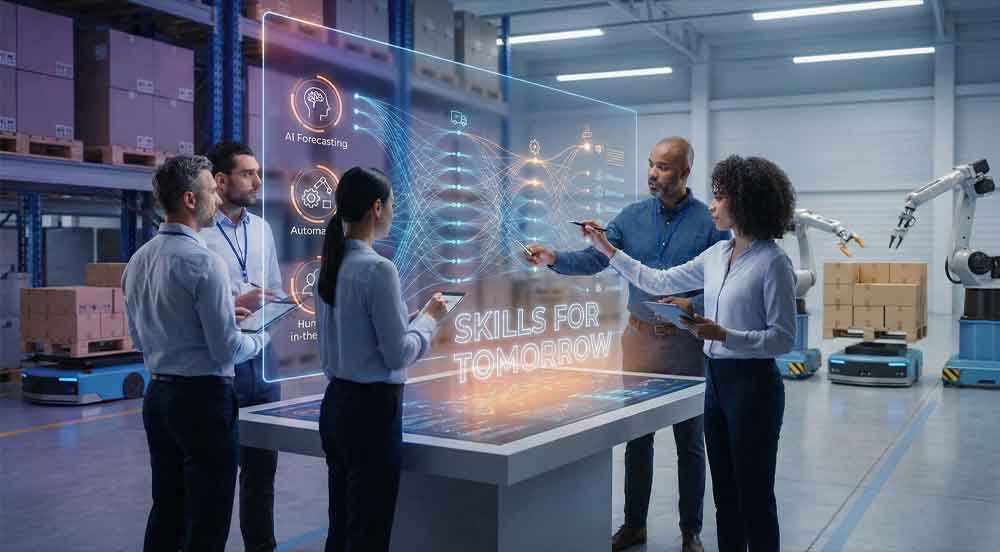
The future of fulfillment isn’t robotic — it’s hybrid.
People design the flow.
Robots scale the flow.
What Robots Should Do
- Repeatable travel
- Long hauls
- Unit-to-unit shuttling
- Predictable transport
- Delivering work to the constraint
What People Should Do
- Quality decisions
- Exception work
- Problem solving
- Method optimization
- Process simplification
- Continuous improvement
The combination is powerful.
Human-designed processes give the robots something worth scaling.
Reducing Touches + TOC: The Two Levers That Control Everything
Strip it all down and warehouse throughput is governed by two things:
1. Reduce touches.
Every eliminated touch removes waste, increases speed, and strengthens flow.
2. Elevate the constraint.
All throughput gains come from the bottleneck — whether it’s manual, robotic, or space-related.
Robotics makes these two levers more important, not less.
Automation accelerates the parts of the process that are ready.
Humans improve the parts that are not.
That’s SHIP8’s operating model.
Conclusion: Throughput Comes From Humans — Scaled by Robots
Automation has changed fulfillment, but not in the way people imagine.
The greatest multiplier in a warehouse isn’t a robot — it’s a team that understands flow, reduces touches, and applies the Theory of Constraints daily.
Robots amplify the system.
People shape it.
And when both are aligned, throughput becomes predictable, stable, and scalable.
That’s what actually improves performance in a modern 3PL.
And it’s why SHIP8 continues to invest in both automation and the people who make it run.