In 2026, capital is still flowing into logistics — but with far more scrutiny than in years past.
Across private equity, strategic buyers, and institutional investors, one shift is clear: growth narratives alone no longer command premium 3PL valuation. Instead, investors are prioritizing operational proof, risk reduction, and scalability that holds up under real diligence.
At SHIP8, these are the same questions we see emerging in enterprise RFPs, diligence conversations, and strategic reviews.
One message is consistent across investor research and transaction benchmarks: Investors are no longer funding promises. They are funding systems.
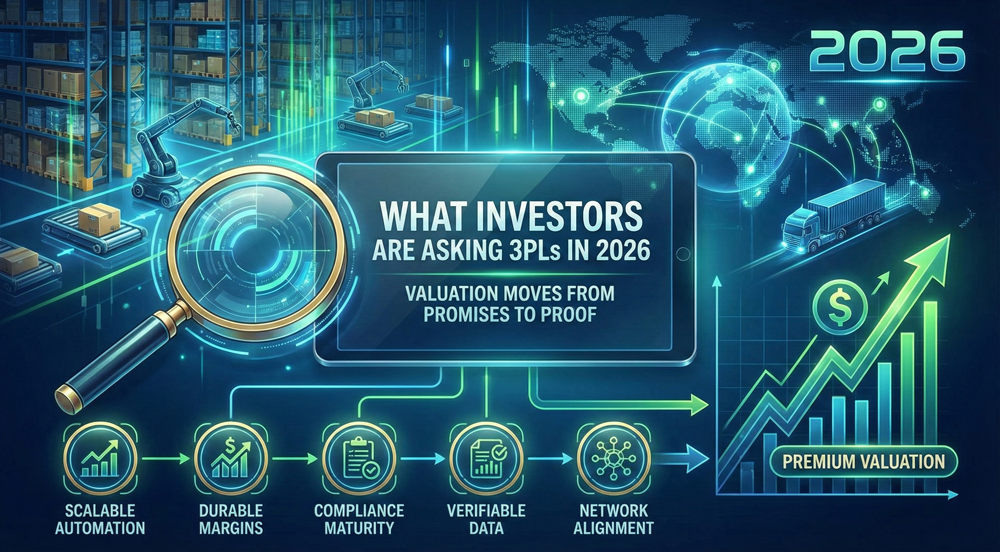
Below are the five questions investors are actually asking 3PLs in 2026, and why the answers directly impact 3PL valuation.

What Do Investors Look for in 3PLs in 2026?
Today’s investors look for logistics operators with:
- Scalable automation
- Durable margins
- Compliance maturity
- Verifiable, trustworthy data systems
Revenue growth still matters — but growth without operational discipline no longer earns premium multiples. The ability to scale without linear labor increases and without introducing execution risk is now table stakes.

1. Can This 3PL Scale Without Linear Labor Growth?
Automation is no longer a differentiator — it is an expectation.
What separates high-value 3PLs from the rest is whether automation is structural, deeply integrated into workflows, and financially disciplined.
Research from McKinsey & Company shows that automation delivers meaningful productivity gains only when paired with process redesign and KPI accountability. Investors now look beyond robotics demos and focus on throughput stability, labor elasticity, and failure points at scale.
Investor focus areas include:
- Labor cost per unit before and after automation
- Peak-season throughput stability
- Integration between WMS, automation, and reporting
- Ability to scale volume without proportional headcount increases
Automation paired with redesigned workflows can deliver 20–30% productivity gains and Automation without process change delivers minimal margin improvement
Source: McKinsey & Company
2. How Durable Are Margins During Volatility?
In 2026, investors assume economic cycles, labor pressure, and demand swings are unavoidable. The real question is how well a 3PL performs when conditions tighten.
According to Armstrong & Associates, margin durability is strongest among operators that:
- Diversify service offerings
- Limit customer concentration
- Control cost variability through process maturity
Investors now examine:
- Customer concentration risk
- Margin performance by service line
- Sensitivity to labor and fuel volatility
SHIP8’s diversified model — spanning oversized fulfillment, regulated verticals, and enterprise customers — helps reduce exposure to any single market cycle.
Diversified 3PLs experience lower EBITDA volatility during downturns. Labor-linear models face faster margin compression
Source: Armstrong & Associates

3. Is Compliance a Cost Center — or a Competitive Moat?
Compliance has shifted from a back-office function to a valuation driver.
Guidance from U.S. Customs and Border Protection and the FDA has raised expectations across logistics networks, especially for medical devices, food-adjacent supply chains, and cross-border operations.
Investors increasingly treat compliance maturity as:
- Downside risk protection
- A customer retention lever
- Evidence of governance discipline
SHIP8’s alignment with CTPAT-grade security practices and FDA-ready workflows positions compliance not as overhead, but as an operational moat.

Compliance gaps are now flagged as valuation discounts, not operational issues. Investors associate compliance maturity with lower execution risk
Source: PwC

4. Can Leadership Prove the Numbers?
In 2026, investors assume dashboards exist. What they test is credibility.
KPMG notes that one of the most common diligence failures in logistics transactions is inconsistent KPI definitions across sites and leadership levels.
Investors evaluate:
- KPI lineage from floor to executive view
- Consistency between reported metrics and observed operations
- Forecasting grounded in historical variance, not optimism
SHIP8 emphasizes real throughput data, process-level productivity metrics, and site-specific visibility — reducing execution risk and increasing investor confidence.

KPI inconsistency is a top diligence red flag in logistics M&A. Clean data lineage improves deal confidence and close velocity
Source: KPMG

5. Does the Network Actually Support the Strategy?
Location still matters — but only when it aligns with execution.
Research from the MIT Center for Transportation & Logistics shows that adaptable, port-aligned networks outperform rigid footprints during disruption.
SHIP8’s Savannah-based logistics presence supports:
- East Coast import velocity
- Resilient inbound-to-outbound flows
For investors, this alignment between geography and service specialization reduces systemic risk.

Adaptable logistics networks outperform static ones during disruptions. Port-aligned fulfillment reduces inbound variability and downstream cost
Source: MIT Center for Transportation & Logistics

Final Takeaway: Proof Is the New Pitch
In 2026, investors aren’t asking 3PLs to be visionary.
They’re asking them to be verifiable.
The 3PLs commanding premium valuation consistently demonstrate:
- Scalable automation
- Durable margins
- Compliance maturity
- Data credibility
- Network alignment
These are no longer marketing claims. They are operational requirements — and increasingly, they’re what capital rewards.
Investor FAQs About 3PLs in 2026
Because automation reduces labor risk, improves scalability, and stabilizes margins — but only when it delivers measurable ROI.
Yes. Compliance reduces regulatory risk, increases customer retention, and lowers downside exposure, which investors price directly into valuation.
Yes, but growth without margin durability and operational proof no longer commands premium multiples.
Throughput per labor hour, margin by service line, customer concentration ratios, automation ROI, and compliance audit readiness.
Networks aligned to ports, infrastructure, and service specialization reduce execution risk and improve long-term resilience.