What Is a Bonded Warehouse? How Importers Delay Duties & Improve Cash Flow in Savannah
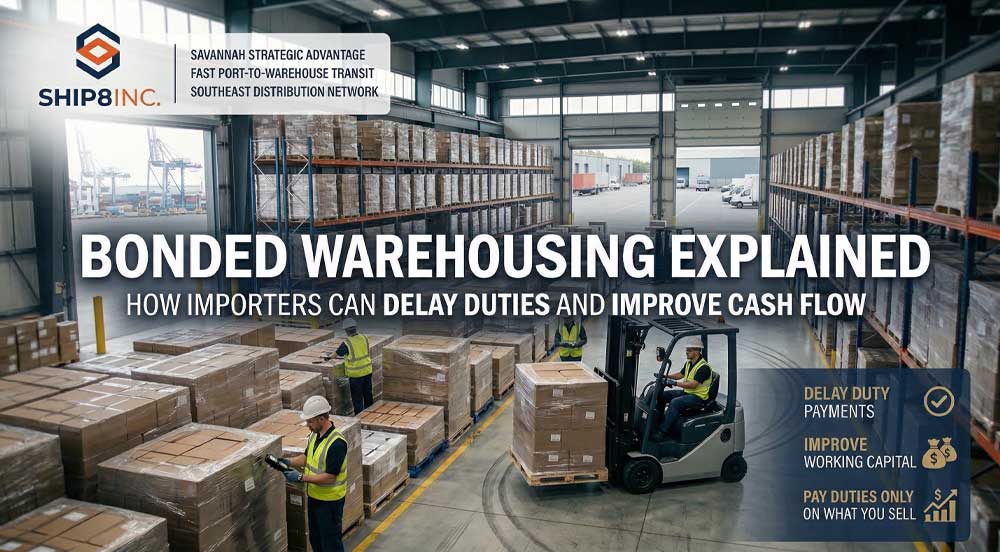
A bonded warehouse is a secure, customs-authorized facility where imported goods can be stored without immediately paying duties or taxes. Duties are only paid when goods are released into the domestic market, allowing importers to improve cash flow, delay tax liabilities, and manage inventory more strategically.
In today’s global supply chain, cash flow is just as important as speed. For importers bringing goods into the United States, one of the most powerful — yet underutilized — tools for improving financial flexibility is bonded warehousing.
Whether you’re managing seasonal inventory, navigating tariffs, or scaling ecommerce operations, bonded warehouses can provide a strategic advantage.
What Is a Bonded Warehouse?
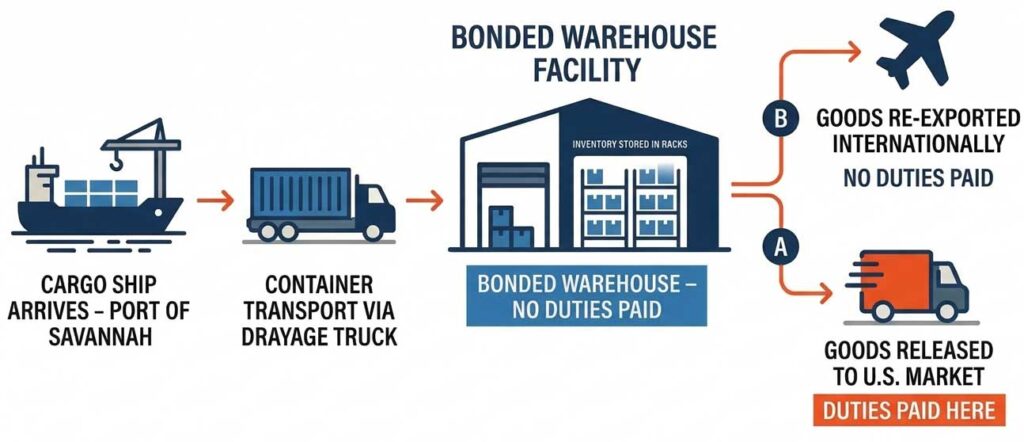
Bonded warehouses operate under the oversight of U.S. Customs and Border Protection (CBP) and are designed to securely store imported goods while deferring duties and taxes until they are released into the domestic market.
Instead of paying duties when your goods arrive at port, you only pay when inventory is withdrawn for distribution.
This means your inventory can sit in storage — sometimes for extended periods — without tying up capital in duties.
To further streamline inbound logistics, we work closely with our partner company OA Express, a trusted drayage provider certified to handle bonded freight—ensuring a seamless, end-to-end solution from port to warehouse.
How SHIP8 Supports Bonded Warehousing
At SHIP8, we provide secure, compliant bonded warehouse solutions designed to give importers more control over their supply chain and cash flow.
Our capabilities include:
Bonded storage and inventory management
Real-time inventory visibility
Container devanning and drayage coordination
Value-added services (labeling, kitting, prep)
Scalable fulfillment operations
We help importers turn bonded warehousing from a compliance requirement into a competitive advantage.
Frequently Asked Questions About Bonded Warehousing
What is the purpose of a bonded warehouse?
A bonded warehouse allows importers to store goods without paying duties until the inventory is sold or released into the domestic market. This helps businesses improve cash flow and better align costs with revenue.
What are the advantages of a bonded warehouse?
The main advantages include: Delayed duty payments Improved cash flow No duties on re-exported goods Greater inventory flexibility Strategic positioning near ports and distribution hubs
What is the difference between a bonded warehouse and a normal warehouse?
In a bonded warehouse, duties and taxes are deferred until goods are withdrawn for domestic use. In a standard warehouse, duties are paid immediately upon import, which can create a larger upfront financial burden.
Are there any disadvantages to bonded warehousing?
Bonded warehouses require strict compliance with U.S. Customs regulations, detailed inventory tracking, and proper documentation. However, for most importers, the financial and operational benefits outweigh these requirements.
How long can goods stay in a bonded warehouse?
In the United States, goods can typically remain in a bonded warehouse for up to five years, depending on the type of warehouse and regulatory conditions.
Final Thoughts
Bonded warehousing isn’t just about delaying duties — it’s about unlocking flexibility, improving cash flow, and optimizing your supply chain strategy.
For importers navigating today’s complex logistics environment, it can be a game-changing solution.
Share This!
Request Fulfillment Quote
Learn why hundreds of brands trust SHIP8 INC. for their fulfillment & logistics needs. Get in touch today!
We use cookies to improve your experience, analyze traffic, and support marketing efforts.
You can accept all cookies or manage your preferences to disable non-essential tracking at any time.
Functional
Always active
The technical storage or access is strictly necessary for the legitimate purpose of enabling the use of a specific service explicitly requested by the subscriber or user, or for the sole purpose of carrying out the transmission of a communication over an electronic communications network.
Preferences
The technical storage or access is necessary for the legitimate purpose of storing preferences that are not requested by the subscriber or user.
Statistics
The technical storage or access that is used exclusively for statistical purposes.The technical storage or access that is used exclusively for anonymous statistical purposes. Without a subpoena, voluntary compliance on the part of your Internet Service Provider, or additional records from a third party, information stored or retrieved for this purpose alone cannot usually be used to identify you.
Marketing
The technical storage or access is required to create user profiles to send advertising, or to track the user on a website or across several websites for similar marketing purposes.